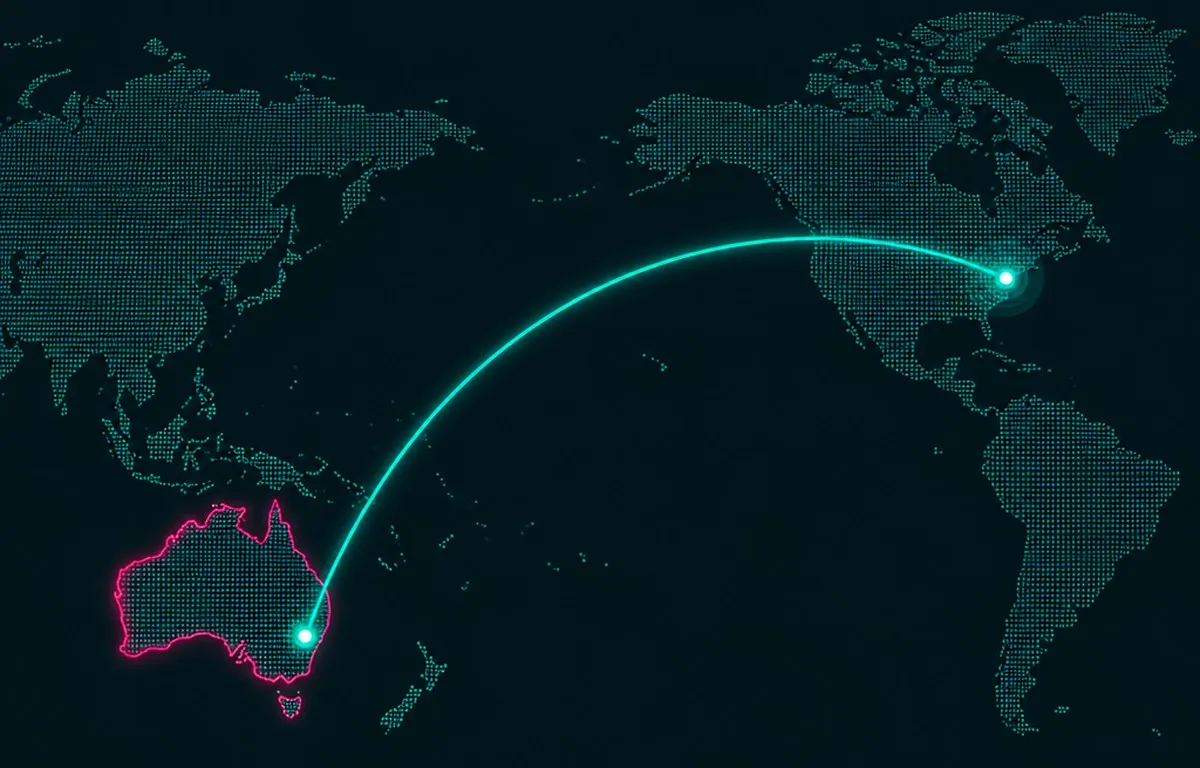
A Canberra company, Trellis Data, recently opened a 220-billion-parameter AI model — trained and hosted entirely in Australia — to the public. The pitch is straightforward: an Australian alternative to US-built, US-hosted models.
The response to that pitch may be something straightforward: “our data’s already hosted in Australia, so we’re covered.”
However, that response conflates two different things. One is data residency — where your data is physically stored. The other is data control — who can be compelled to hand that data over, or can unilaterally switch off the service it runs on, regardless of where the servers sit.
Most enterprise AI deployments already have the first. Almost none have thought seriously about the second, because until this year there wasn’t a clean, public example of why it mattered.
Now there is.
Sovereignty addresses two risks, not one
“Sovereign AI” gets sold as a single concept, but it’s really answering two separate questions, and residency only answers one of them badly and the other not at all:
- Can a foreign government compel your AI vendor to disclose your data? This is about confidentiality and who can see what you’ve put into the system, particularly without your permission.
- Can a foreign government force your AI vendor to switch the service off? This is about availability and whether your tool will even work tomorrow, as we saw in June with Anthropic.
Hosting your data in an Australian data centre doesn’t actually resolve either question if the company running that data centre, or the company whose model is processing your prompts, is still a US entity answerable to US law.
That’s the business case for Trellis Data that is made concrete.
Risk 1: compelled disclosure
The US CLOUD Act (2018) lets a US court order a US-headquartered company to produce data in its “possession, custody, or control” — regardless of where that data is physically stored.
This is the US Department of Justice’s own description of the Act, and it’s exactly the question the Act was written to settle: it followed a case where Microsoft refused to hand over emails stored on a server in Ireland, arguing US courts had no reach over data sitting overseas (DOJ CLOUD Act white paper). Congress’s answer was that it doesn’t matter where the server is; if the company is American, a US court order reaches its data (Skadden, “Understanding the CLOUD Act’s Expansive Reach”).
Running Claude, GPT, or Gemini on an Australian cloud region doesn’t change the entity behind it. Anthropic, OpenAI, and Google are still US companies. A US legal order can still compel disclosure, residency notwithstanding.
There’s one nuance worth noting: what counts as a provider’s “control” over data that’s encrypted such that the provider holds no key hasn’t been fully tested in court. The CLOUD Act’s reach over data that is in possession and custody is settled; what happens in situations where the provider has no direct access to the data is unknown.
It’s also worth noting that Australia signed a CLOUD Act agreement with the US, in force since January 2024. This is a reciprocal channel that lets each country’s law enforcement request data directly from the other’s providers for serious crime (DOJ/AG joint statement; itnews.com.au). In that sense, the Australian government is well aware of this extended reach and has accepted it.
Risk 2: forced unavailability
The disclosure risk is about confidentiality. This second risk is about whether the tool will still be accessible, and it’s the one the Trellis Data conversation is really circling.
On 12 June 2026, the US Commerce Secretary directed Anthropic to suspend foreign-national access to two specific models — Claude Fable 5 and Claude Mythos 5 — under an export-control directive. Both models ran on shared infrastructure with no way to technically separate foreign users from domestic ones, so the only practical way to comply was to pull both models for everyone, Australian customers included, while Anthropic’s other models stayed available. This came with little warning, and the shutdown lasted 19 days.
This happened independently of any terms in any consumer/vendor contract, conduct, or relationship change. This switch was held all the way up to Anthropic, influenced by a US government that Australia didn’t vote in. Data residency offers no protection against this at all, because the thing being withdrawn isn’t data, it’s access to an AI model.
For most firms, a 19-day gap in one product is an inconvenience, provided there’s a fallback and the workload isn’t embedded somewhere with no human alternative. But “provided there’s a fallback” is the operative clause, and companies should heed this caution to not make their business processes totally dependent on AI models, especially ones run by foreign companies.
Where Australian law already treats control as the real question
Australian law and government policy already draw the residency/control line explicitly, in several places:
Government PROTECTED-level data. The ASD’s Hosting Certification Framework — mandatory for new government hosting contracts since 30 June 2022 — requires certified providers to address sovereignty, ownership, control, supply chain and transparency, not merely where the data sits (hostingcertification.gov.au). This is the most obvious existing precedent in Australian policy that “sovereignty” means who controls the service, not just the postcode it sits in.
Critical infrastructure. The Security of Critical Infrastructure Act’s Part 2A requires a risk management program for entities in sectors like energy, water, finance and communications. Its Foreign Ownership, Control and Influence (FOCI) rules apply specifically to high-risk assets, and the government holds directive power to force the removal of a vendor found to pose a national security risk (CISC enhanced CIRMP factsheet). For firms in those sectors, a foreign-controlled AI vendor isn’t a mere worry; it’s a named legal risk category.
Regulated financial entities. APRA’s CPS 230, in force since 1 July 2025, requires APRA-regulated entities to identify “material service providers” and manage concentration risk, with explicit board-level accountability (APRA CPS 230). APRA hasn’t named AI vendors specifically in this standard, but an AI provider sits inside that obligation exactly like any other critical service provider, which means the governance question “why are we this dependent on one vendor we don’t control” has to be answered either way.
While none of these apply to every business, they give good guidance on which businesses this does affect.
Two different sovereignties: who trained it, and who runs it
The Australian AI landscape that’s emerged around this question splits into two layers that get talked about as one:
Who trained the model? Trellis Data’s Agentaus 1 is a 220-billion-parameter model trained and hosted entirely in Australia (Canberra Times). Earlier-stage efforts in the same lane include Sovereign Australia AI and Maincode’s “Matilda,” both pursuing Australian-trained, Australian-owned models, and SierraBlue, aimed at defence and disconnected environments.
This layer answers: was the model itself ever outside Australian hands?
Who controls the infrastructure it runs on? AUCloud is an Australian-owned cloud provider, IRAP-assessed to the ASD’s PROTECTED controls across Canberra, Sydney, Brisbane and Melbourne (AUCloud). SCX.ai, an ASX-listed provider, activated what it describes as Australia’s first sovereign AI inferencing node in Sydney in early 2026 (HPCwire). Macquarie Government runs Azure-based managed services for PROTECTED-level government work, as one of four sovereign Azure managed service providers in the country (idm.net.au).
This layer answers a different question: regardless of whose model it is, who can be ordered to turn it off or hand over what passed through it?
Recognising this split matters from a practical perspective: a firm that needs to satisfy a control requirement doesn’t necessarily need an Australian-trained model at all. It may only need an Australian-controlled way to run the model it already uses. This reduces the sovereignty compliance activities down to an infrastructure challenge instead of also undergoing significant reworks of the software that uses the model.
Three questions to see if sovereignty is relevant for you
Before treating sovereignty as either a requirement or a non-issue, three questions will help settle it:
- Is this workload already under a sovereignty mandate? PROTECTED-level government data, a critical-infrastructure sector, anything touched by Foreign Ownership, Control and Influence rules?
- Could a sudden, multi-week outage of this one model break something with no fallback? Not “would it be annoying,” but would it actually break a process with no human alternative, or at minimum, no fallback model to shift to even if it’s a weaker one?
- Is the data privileged or sensitive enough that being compelled to disclose it under a foreign legal order is unacceptable? Regardless of how unlikely that order is?
None of the three: capability and cost should decide, and the sovereignty argument is mostly noise for your situation.
One or more genuinely true: sovereignty is a real requirement, and the fix is either an Australian-trained model, an Australian-controlled infrastructure layer underneath an existing model, or both. Data or model residency should not be assumed as “we’re already covered” because a data centre happens to be in Sydney.
Where this framework falls short
It doesn’t quantify likelihood. None of the risks outlined say how likely compelled disclosure or forced unavailability actually is. The core message is residency does not solve for these risks, so plan accordingly. For most commercial workloads, both risks are real but low-probability.
The vendor landscape is young and moves fast. Several of the Australian options named here — Trellis Data, SCX.ai, Sovereign Australia AI, Maincode — are recent, some still scaling, and claims about model benchmarks or certification scope should be re-verified against current information before any procurement decision, and not taken from this post or from a vendor’s own announcement as granted.
This is a control framework, not a comprehensive software fit-for-purpose or quality assessment. An Australian-controlled, Australian-trained model satisfies every control question above and can still be the wrong tool for a given task. Sovereignty and fit-for-purpose are different tests to determine answers to different questions.